
Маю сумнів що для кожної платформи будуть робити окремо руцями мапу для того інстаграм-фільтру, уніфікують та зроблять загальну модель для роботи ШІ. Це навіть тереотично має зменшити навантаження для роботи технології бо буде менш марити що і де домальовувати.MqM: ↑ 17.03.2026 13:35тобто будуть спрощені модельки персонажів, чкі задаватимуть напрям генерації для нейронок? Яке прекрасне майбутнєman1242: ↑ 17.03.2026 13:29
Ну що nerual rendering буде масовим то факт, на консолях вже пітверджено що буде аналогічна функція як некст ген фіча для продажу нового покоління, тому маю думку що буде глобал пресет для усього нейроного сміття ще на стадії розробки.

Новини
Останні статті і огляди
NVIDIA показала революційну технологію NVIDIA DLSS 5 — нейронний рендеринг для кінематографічної графіки
-
man1242
Member

- Звідки: Кривий Ріг
-
RomulusXIII
Member

- Звідки: Львів
Загалом технологія досить переспетивна, все залежить від кінцевої реалізації і імпакта на перформанс.
Але чому НВ вирішили взяти для презентації такі погані приклади не зрозуміло.
Але чому НВ вирішили взяти для презентації такі погані приклади не зрозуміло.
-
bes
Member
- Звідки: Kryvyi Rih
Реализм от хуанга который мы ждем
-
alexeygalas
Member

- Звідки: Khmelnytskyi
Те що я бачу - це скарб
-
man1242
Member
- Звідки: Кривий Ріг
Приклади то непогані але коли в тебе "фотореалістичне" обличя а анімація у грі дуже куца та обмежена то це одразу бросаєтся на очі, враження наче від згенерованого дженеріка.RomulusXIII: ↑ 17.03.2026 13:43 Загалом технологія досить переспетивна, все залежить від кінцевої реалізації і імпакта на перформанс.
Але чому НВ вирішили взяти для презентації такі погані приклади не зрозуміло.
-
dead_rat
Member

- Звідки: Берлін
Вони взяли НАЙКРАЩІ приклади, вочевидь все інше було гіршеRomulusXIII: ↑ 17.03.2026 13:43 Загалом технологія досить переспетивна, все залежить від кінцевої реалізації і імпакта на перформанс.
Але чому НВ вирішили взяти для презентації такі погані приклади не зрозуміло.
-
Tetronga
Member
Ще й спеціально графіку не поставили на максимум в іграх, щоб був сильніший ефект від зміни освітлення/контрасту/перешарпу на прикладі з длсс5dead_rat: ↑ 17.03.2026 13:54Вони взяли НАЙКРАЩІ приклади, вочевидь все інше було гіршеRomulusXIII: ↑ 17.03.2026 13:43 Загалом технологія досить переспетивна, все залежить від кінцевої реалізації і імпакта на перформанс.
Але чому НВ вирішили взяти для презентації такі погані приклади не зрозуміло.

-
hohlid19
Member
То, что ты/вы скинули сверху, может много что обозначать. По факту рендеринг будет заключаться в апскейле обычном, ибо не забываем, что консоли на АМДman1242: ↑ 17.03.2026 13:29 на консолях вже пітверджено що буде аналогічна функція як некст ген фіча для продажу нового покоління
- спойлер
- а как говорил многоуважаемый товарищ эркинс—этого на АМД не будет 10 лет
-
RomulusXIII
Member
- Звідки: Львів
Тут згоден. Загалом, якщо розробники матимуть можливість крутити інтенсивність цього всього і можливо якісь інші параметри, то може бути гарний результат. Осінню побачимоman1242: ↑ 17.03.2026 13:53 Приклади то непогані але коли в тебе "фотореалістичне" обличя а анімація у грі дуже куца та обмежена то це одразу бросаєтся на очі, враження наче від згенерованого дженеріка.

-
Bukakanga
Member
о, а Эбби из Ласт оф Асс Джва кто-то уже через фильтры прогонял? )))
-
erkins007
Member

Все, Хуанг разорен будет.dfcz: ↑ 17.03.2026 11:12Если это реально будующее геймдева, то я снова куплю карту от АМД.
Отправлено спустя 2 минуты 56 секунд:
Прекрасно включит. Прям на презентации(наверное специально для красных клоунов, которые щас на гной исходят) было заявлено что к релизу это все будет работать на одной карте, две использовались чисто для прототипирования.vsx: ↑ 17.03.2026 12:52Уже начал откладывать на вторую 5090? Длсс 5 сам себя не включит
И да, я не устану повторять что если вам нужно откладывать на покупку видеокарты, то вам не нужно ее покупать - покупайте ту модель, на которую откладывать нет нужды.
-
oversteve
Member

- Звідки: Ukraine
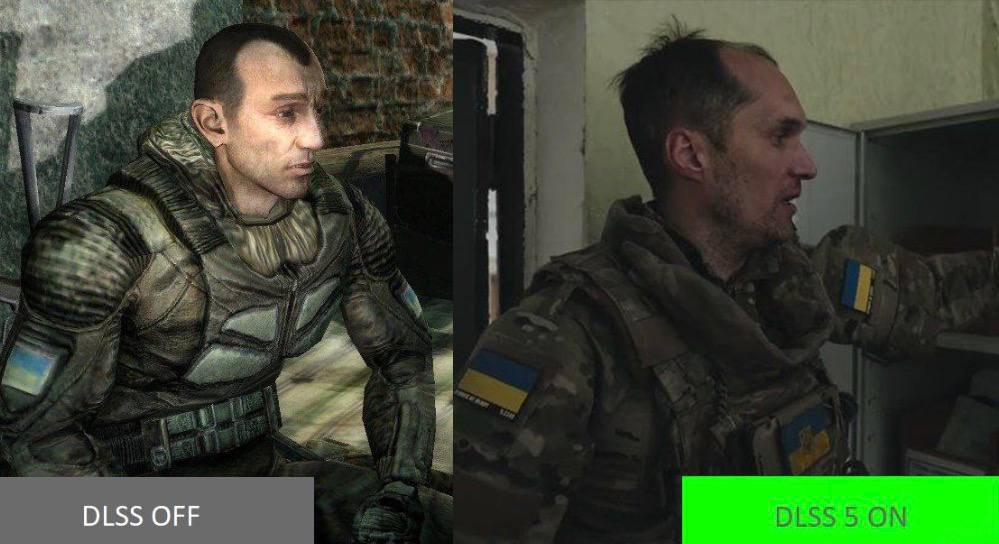

-
Bukakanga
Member
эффект мыла и зернистости особо хорошо удался на примерах чуть выше )))
-
SeptemberVibe
Junior
Та что не нойте, это будущееI Just Saw DLSS 5 Running Across Multiple Games. It's Not a Face Filter.
NVIDIA just dropped DLSS 5 at GTC 2026, and the internet already has opinions.
I was in the room and I went hands-on. Not watching a sizzle reel, not scrubbing through a carefully curated 30-second trailer, but sitting in front of multiple games with DLSS 5 toggling on and off in real time. Hogwarts Legacy. Starfield. Assassin's Creed Shadows. Oblivion Remastered. The Zorah tech demo. The visual improvements are significant. Not incremental. Significant.
But if you've been scrolling social media, you'd think NVIDIA just shipped an Instagram beauty filter for video games. And I get why that's the first reaction. But it misses the true picture by a wide margin.
Why Faces Get All the Attention
We've had photorealistic environments in games for a while now. Water reflections, volumetric lighting, incredibly detailed cityscapes and forests. The hardware and the rendering techniques have gotten us to a place where environments can look stunning under the right conditions.
But faces have been the holdout. Getting a human face to look truly photorealistic in real time has been one of the most expensive problems in computer graphics from a compute standpoint. Subsurface scattering on skin, the way light interacts with individual strands of hair, the micro-expressions that make a character feel alive rather than like a wax figure. All of that requires an enormous amount of rendering horsepower..
I've probably seen ten different "floating head" tech demos over the course of my career. That's not an exaggeration. They're always a single head with no hair, no body, no environment, because rendering a photorealistic face at that level of quality is so expensive that it can only be done in isolation. You never see it inside an actual game, because the performance budget won't allow it.
DLSS 5 closes that gap in a pretty dramatic way. And because that's the area where the delta between "before" and "after" is most visible, that's what everyone is reacting to. The NVIDIA team put it well during my demo. It's a psychological effect. You've seen environments rendered really well before. When you suddenly see a character rendered at that same photorealistic level, your brain flags it immediately. It stands out.
Fair enough. But focusing only on the faces is wrong.
It's Happening Everywhere, Not Just on Character Models
What I saw in the demos was a comprehensive improvement across the entire scene. And the moment that really drove this home wasn't a face. It was a coffee maker.
In Starfield, there's a countertop scene with a coffee machine, some paper towels, a cup, napkin holders. Standard environmental clutter. With DLSS 5 off, everything looks flat. The coffee maker fades into the background. Toggle it on, and suddenly the objects have shape. The lighting wraps around them naturally. The spatial relationships between the items and the surfaces they're sitting on become clear. It goes from "assets placed in a scene" to "objects that actually belong in a room."
The same thing played out across every title. In Oblivion Remastered, the water went from good video game water to something that could pass for real, with the kind of light interaction and shimmer you'd expect from an offline render. In Assassin's Creed Shadows, the trees and distant foliage gained dramatically better depth and separation in how light moved from the canopy down through the branches. In the Zorah tech demo, which is a 300 GB courtyard scene built by 20 full-time artists, the subsurface scattering on foliage was just as impressive as anything happening on character faces. Leaves picked up that translucent glow from backlighting that is incredibly difficult and expensive to model and render through traditional means.
The AI model powering DLSS 5 is a single unified model. Same model for every game. It's not trained per-title, per-face, or per-object type. It takes the raw color buffer and motion vectors as input, analyzes the scene semantics from that single frame, and enhances the lighting and material response while staying anchored to the original 3D content. It recognizes the difference between skin and metal and water and stone and foliage, and it processes each of those materials differently based on how light should interact with them.
That's not a filter. That's a fundamentally different approach to how the final image gets assembled. And it's deterministic and consistent from frame to frame, which is a hard requirement for games.
The Developer Angle Matters More Than People Realize
One of the things I came away most encouraged by is the developer control story. This is critical. If DLSS 5 were a black box that slapped a one-size-fits-all enhancement over every game, the artistic intent concerns would be completely valid. But that's not what this is.
During the demo, the DLSS research talked through the level of granularity available. Developers don't just get an on/off switch. They get intensity controls that can be dialed anywhere, not just full strength. They get spatial masking, so they can set the water enhancement to 100%, wood to 30%, characters to 120%, all independently within the same scene. They get color grading controls for blending, contrast, saturation, and gamma. All of this runs through the existing SDK, which means studios already using DLSS and Reflex have a familiar pipeline to work with.
The developer support list tells you something. Bethesda, CAPCOM, Ubisoft, Tencent, Warner Bros. Games, and others have already signed on. But what struck me more than the names was what the NVIDIA team shared about the reactions inside those studios. When developers previewed the technology, their technical artists were apparently co-advocating for it internally, because it gets them closer to what they actually intended their characters and environments to look like when they were designing them in their authoring tools. Then those assets get dropped into a real-time game engine with a finite performance budget, and compromises happen. DLSS 5 lets them claw back some of what gets lost in that translation.
I think that's the right framing. DLSS 5 isn't NVIDIA applying its stylistic choices on top of someone else's game. It's providing a tool that helps developers close the gap between what they can render in 16 milliseconds and what they actually want the player to see. That's a meaningful distinction, and it's a big reason why the developer response has been positive.
The Hardware Story Is Interesting Too
The demos I saw were running on a pair of RTX 5090 GPUs. One was handling the game rendering, the other was dedicated entirely to running the DLSS 5 AI model. NVIDIA was upfront that there's still significant optimization work to do, and the plan is to ship DLSS 5 running on a single GPU when it launches later this year.
But I think the dual-GPU setup itself is worth mentioning. For years, multi-GPU gaming has been effectively dead. SLI is gone. CrossFire is gone. The idea that you'd run two graphics cards for a better gaming experience felt like a relic of the mid-2000s. And yet here we are, with a legitimate use case where a second GPU running an AI workload alongside a primary rendering GPU produces a dramatically better visual result.
Is that where this ends up for enthusiasts? Probably not at launch. But the concept of dedicating GPU compute specifically to AI-driven visual enhancement, separate from the rendering pipeline, is an interesting architectural idea. It wouldn't surprise me if that becomes a real conversation again as neural rendering matures.
Where This Goes From Here
DLSS 5 is targeting a fall 2026 launch, which means we've got several months of optimization and refinement ahead. Developers are just getting their hands on it now, and they'll need time to work with the controls and dial in the right settings for their specific titles. First-wave games include Starfield, Assassin's Creed Shadows, Resident Evil Requiem, Hogwarts Legacy, Phantom Blade Zero, The Elder Scrolls IV: Oblivion Remastered, Delta Force, and more.
It's also worth noting that this works across rendering approaches. Rasterized games, ray-traced titles, and path-traced experiences all benefit. And the higher the fidelity of the input, the better the output. DLSS 5 isn't replacing good rendering. It's amplifying it.
The early social media reaction is predictable. New technology that changes how games look will always generate strong opinions, especially when AI is involved. But the knee-jerk "it's just a face filter" take doesn't hold up once you've actually seen the full scope of what DLSS 5 is doing across an entire scene, across multiple games, in real time. Go look at a coffee maker. Go look at stone textures. Go look at the way light passes through a leaf. That's where the real story is.
What do you think, is neural rendering the next big unlock for game visuals? I'd love to hear from people who have spent time with these games.
-
МОНАХ
Member

- Звідки: Український Шаолінь
► "Сильно" - це ще м'яко сказаноАле обличчя сильно змінюються.
 . Судячи з картинки Грейс - зліва, це, коли я (якщо говорити за малювання вручну) детальну базу завершив, а справа - вже розмалював до 95% готовності. В проміжку - там до фінальної картинки можна геть іншу людину "зліпити". І це я - вручну розумію, кого я маю намалювати, а ШІ - чого?
  Це дійсно на різних рівнях якості графіки може бути дві візуально різні гри; пограв на старенькій карті в 30 фпс на лоу-рівні, поміняв карту на сучасну - бац! і вже сенс перепройти, бо сприйматиметься як ремейк
  .
.► Триллер "SLI 2026: потужність забутих предків"...демонстрація технології проводилася на системі з двома відеокартами GeForce RTX 5090 — одна запускала гру, а друга забезпечувала роботу DLSS 5...
 (або комедія... побачимо.)
Востаннє редагувалось 17.03.2026 15:23 користувачем МОНАХ, всього редагувалось 1 раз.
-
dead_rat
Member
- Звідки: Берлін
Чому тоді це писав чатГПТ, а не людина? Так вразило?SeptemberVibe: ↑ 17.03.2026 15:11Та что не нойте, это будущееI Just Saw DLSS 5 Running Across Multiple Games. It's Not a Face Filter.
NVIDIA just dropped DLSS 5 at GTC 2026, and the internet already has opinions.
I was in the room and I went hands-on. Not watching a sizzle reel, not scrubbing through a carefully curated 30-second trailer, but sitting in front of multiple games with DLSS 5 toggling on and off in real time. Hogwarts Legacy. Starfield. Assassin's Creed Shadows. Oblivion Remastered. The Zorah tech demo. The visual improvements are significant. Not incremental. Significant.
But if you've been scrolling social media, you'd think NVIDIA just shipped an Instagram beauty filter for video games. And I get why that's the first reaction. But it misses the true picture by a wide margin.
Why Faces Get All the Attention
We've had photorealistic environments in games for a while now. Water reflections, volumetric lighting, incredibly detailed cityscapes and forests. The hardware and the rendering techniques have gotten us to a place where environments can look stunning under the right conditions.
But faces have been the holdout. Getting a human face to look truly photorealistic in real time has been one of the most expensive problems in computer graphics from a compute standpoint. Subsurface scattering on skin, the way light interacts with individual strands of hair, the micro-expressions that make a character feel alive rather than like a wax figure. All of that requires an enormous amount of rendering horsepower..
I've probably seen ten different "floating head" tech demos over the course of my career. That's not an exaggeration. They're always a single head with no hair, no body, no environment, because rendering a photorealistic face at that level of quality is so expensive that it can only be done in isolation. You never see it inside an actual game, because the performance budget won't allow it.
DLSS 5 closes that gap in a pretty dramatic way. And because that's the area where the delta between "before" and "after" is most visible, that's what everyone is reacting to. The NVIDIA team put it well during my demo. It's a psychological effect. You've seen environments rendered really well before. When you suddenly see a character rendered at that same photorealistic level, your brain flags it immediately. It stands out.
Fair enough. But focusing only on the faces is wrong.
It's Happening Everywhere, Not Just on Character Models
What I saw in the demos was a comprehensive improvement across the entire scene. And the moment that really drove this home wasn't a face. It was a coffee maker.
In Starfield, there's a countertop scene with a coffee machine, some paper towels, a cup, napkin holders. Standard environmental clutter. With DLSS 5 off, everything looks flat. The coffee maker fades into the background. Toggle it on, and suddenly the objects have shape. The lighting wraps around them naturally. The spatial relationships between the items and the surfaces they're sitting on become clear. It goes from "assets placed in a scene" to "objects that actually belong in a room."
The same thing played out across every title. In Oblivion Remastered, the water went from good video game water to something that could pass for real, with the kind of light interaction and shimmer you'd expect from an offline render. In Assassin's Creed Shadows, the trees and distant foliage gained dramatically better depth and separation in how light moved from the canopy down through the branches. In the Zorah tech demo, which is a 300 GB courtyard scene built by 20 full-time artists, the subsurface scattering on foliage was just as impressive as anything happening on character faces. Leaves picked up that translucent glow from backlighting that is incredibly difficult and expensive to model and render through traditional means.
The AI model powering DLSS 5 is a single unified model. Same model for every game. It's not trained per-title, per-face, or per-object type. It takes the raw color buffer and motion vectors as input, analyzes the scene semantics from that single frame, and enhances the lighting and material response while staying anchored to the original 3D content. It recognizes the difference between skin and metal and water and stone and foliage, and it processes each of those materials differently based on how light should interact with them.
That's not a filter. That's a fundamentally different approach to how the final image gets assembled. And it's deterministic and consistent from frame to frame, which is a hard requirement for games.
The Developer Angle Matters More Than People Realize
One of the things I came away most encouraged by is the developer control story. This is critical. If DLSS 5 were a black box that slapped a one-size-fits-all enhancement over every game, the artistic intent concerns would be completely valid. But that's not what this is.
During the demo, the DLSS research talked through the level of granularity available. Developers don't just get an on/off switch. They get intensity controls that can be dialed anywhere, not just full strength. They get spatial masking, so they can set the water enhancement to 100%, wood to 30%, characters to 120%, all independently within the same scene. They get color grading controls for blending, contrast, saturation, and gamma. All of this runs through the existing SDK, which means studios already using DLSS and Reflex have a familiar pipeline to work with.
The developer support list tells you something. Bethesda, CAPCOM, Ubisoft, Tencent, Warner Bros. Games, and others have already signed on. But what struck me more than the names was what the NVIDIA team shared about the reactions inside those studios. When developers previewed the technology, their technical artists were apparently co-advocating for it internally, because it gets them closer to what they actually intended their characters and environments to look like when they were designing them in their authoring tools. Then those assets get dropped into a real-time game engine with a finite performance budget, and compromises happen. DLSS 5 lets them claw back some of what gets lost in that translation.
I think that's the right framing. DLSS 5 isn't NVIDIA applying its stylistic choices on top of someone else's game. It's providing a tool that helps developers close the gap between what they can render in 16 milliseconds and what they actually want the player to see. That's a meaningful distinction, and it's a big reason why the developer response has been positive.
The Hardware Story Is Interesting Too
The demos I saw were running on a pair of RTX 5090 GPUs. One was handling the game rendering, the other was dedicated entirely to running the DLSS 5 AI model. NVIDIA was upfront that there's still significant optimization work to do, and the plan is to ship DLSS 5 running on a single GPU when it launches later this year.
But I think the dual-GPU setup itself is worth mentioning. For years, multi-GPU gaming has been effectively dead. SLI is gone. CrossFire is gone. The idea that you'd run two graphics cards for a better gaming experience felt like a relic of the mid-2000s. And yet here we are, with a legitimate use case where a second GPU running an AI workload alongside a primary rendering GPU produces a dramatically better visual result.
Is that where this ends up for enthusiasts? Probably not at launch. But the concept of dedicating GPU compute specifically to AI-driven visual enhancement, separate from the rendering pipeline, is an interesting architectural idea. It wouldn't surprise me if that becomes a real conversation again as neural rendering matures.
Where This Goes From Here
DLSS 5 is targeting a fall 2026 launch, which means we've got several months of optimization and refinement ahead. Developers are just getting their hands on it now, and they'll need time to work with the controls and dial in the right settings for their specific titles. First-wave games include Starfield, Assassin's Creed Shadows, Resident Evil Requiem, Hogwarts Legacy, Phantom Blade Zero, The Elder Scrolls IV: Oblivion Remastered, Delta Force, and more.
It's also worth noting that this works across rendering approaches. Rasterized games, ray-traced titles, and path-traced experiences all benefit. And the higher the fidelity of the input, the better the output. DLSS 5 isn't replacing good rendering. It's amplifying it.
The early social media reaction is predictable. New technology that changes how games look will always generate strong opinions, especially when AI is involved. But the knee-jerk "it's just a face filter" take doesn't hold up once you've actually seen the full scope of what DLSS 5 is doing across an entire scene, across multiple games, in real time. Go look at a coffee maker. Go look at stone textures. Go look at the way light passes through a leaf. That's where the real story is.
What do you think, is neural rendering the next big unlock for game visuals? I'd love to hear from people who have spent time with these games.
-
dfcz
Member
Именно так и работает взаимодействие "производитель-потребитель" (ну или "продавец-покупатель" если более маркетологическими терминами).erkins007: ↑ 17.03.2026 15:03Все, Хуанг разорен будет.dfcz: ↑ 17.03.2026 11:12Если это реально будующее геймдева, то я снова куплю карту от АМД.
-
SeptemberVibe
Junior
Запитай в X у автора, який вже 20 років вариться в ПК індустрії)
Цікаво цікаво, а що ви збираєтесь малювати? На листочку А4 чи що? Моделі не "малюють" що це цирк, буквально із полігонів ліплять і роблять форми в умовному блендер чи іще чомусьМОНАХ: ↑ 17.03.2026 15:19► "Сильно" - це ще м'яко сказаноАле обличчя сильно змінюються.
► Триллер "SLI 2026: потужність забутих предків"...демонстрація технології проводилася на системі з двома відеокартами GeForce RTX 5090 — одна запускала гру, а друга забезпечувала роботу DLSS 5...
-
vsx
Member

- Звідки: Kyiv
В АС:Shadows выглядело все отвратительно. Правда его не показали в рекламном ролике, но тем не менееdead_rat: ↑ 17.03.2026 13:54 Вони взяли НАЙКРАЩІ приклади, вочевидь все інше було гірше
-
AndrewV
Member
В смысле чат? Текст от Ryan Shrout https://x.com/ryanshroutЧому тоді це писав чатГПТ, а не людина? Так вразило?